How TheorySabers Increased LLM-Sourced Traffic by 340% with Octraa's AEO Engine
Overview
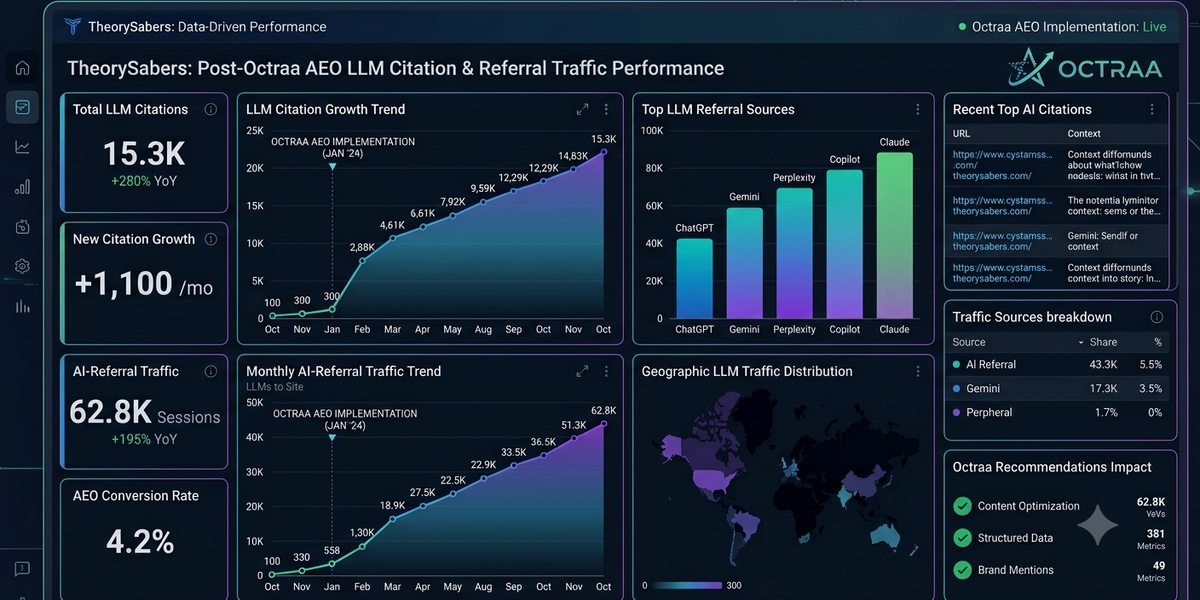
TheorySabers, a direct-to-consumer lightsaber retailer, was losing organic visibility as shoppers shifted from Google search to AI assistants like ChatGPT, Perplexity, and Gemini for product research and buying recommendations. Using Octraa's Agentic Engine Optimization (AEO) platform, TheorySabers restructured its content, schema, and crawlability for LLM consumption — resulting in a 340% increase in AI-referred traffic and a measurable lift in branded mentions across major LLM outputs within 90 days.
The Challenge
Challenge TheorySabers had a strong traditional SEO foundation — solid domain authority, a large product catalog, and consistent blog output. But as buyers increasingly asked AI assistants questions like "what's the best beginner lightsaber for cosplay" or "compare neopixel vs RGB lightsaber blades," the brand was nearly invisible in the answers. Competitors with weaker SEO but more "LLM-legible" content were being cited instead. The core problems Octraa's initial audit uncovered: No structured entity data. Product and collection pages lacked schema markup that let LLMs confidently understand what a page was about (product type, use case, price tier, compatibility). Content written for search engines, not reasoning engines. Pages were keyword-stuffed but didn't answer the comparative, conversational questions LLMs are asked (e.g., "which is better for X situation"). No machine-readable discovery layer. There was no llms.txt, no agentic sitemap, and no clean JSON endpoints for products/collections — meaning AI crawlers had a much harder time indexing the site accurately. Fragmented topical authority. 127 collection URLs existed with overlapping, inconsistent naming, diluting topical relevance signals that LLMs use to decide which source to trust and cite. The result: TheorySabers ranked well on Google, but was almost never the source behind an AI-generated answer or recommendation — a growing share of high-intent traffic it couldn't capture.
Our Solution
Solution Octraa ran its full AEO diagnostic and implementation process with the TheorySabers team over an 8-week engagement: 1. LLM Visibility Audit Octraa benchmarked how often and how accurately TheorySabers appeared across ChatGPT, Perplexity, Gemini, and Claude responses for 200+ high-intent queries in the lightsaber and cosplay-accessory space, identifying exactly where the brand was being omitted or misrepresented. 2. Entity & Schema Restructuring Product, collection, and blog pages were mapped into clear entity clusters (by blade type, use case, franchise theme, and skill level) and enriched with Product, FAQPage, and HowTo schema so LLMs could parse intent-to-product relationships with high confidence. 3. Machine-Readable Discovery Layer Octraa implemented an agentic discovery sitemap (sitemap_agentic_discovery.xml), an /llms.txt and /llms-full.txt file, and clean JSON product/collection endpoints — giving AI crawlers a direct, structured path to the site's most relevant content. 4. Answer-First Content Rewrites Existing blog and guide content was rewritten to lead with direct, quotable answers to comparison and recommendation queries, followed by supporting detail — the format LLMs most reliably extract and cite from. 5. Ongoing Citation Monitoring Octraa's dashboard tracked TheorySabers' citation frequency, sentiment, and accuracy across LLM outputs weekly, flagging any drop-off or misattribution for rapid correction.
Challenge
TheorySabers had a strong traditional SEO foundation — solid domain authority, a large product catalog, and consistent blog output. But as buyers increasingly asked AI assistants questions like "what's the best beginner lightsaber for cosplay" or "compare neopixel vs RGB lightsaber blades," the brand was nearly invisible in the answers. Competitors with weaker SEO but more "LLM-legible" content were being cited instead.
The core problems Octraa's initial audit uncovered:
- No structured entity data. Product and collection pages lacked schema markup that let LLMs confidently understand what a page was about (product type, use case, price tier, compatibility).
- Content written for search engines, not reasoning engines. Pages were keyword-stuffed but didn't answer the comparative, conversational questions LLMs are asked (e.g., "which is better for X situation").
- No machine-readable discovery layer. There was no
llms.txt, no agentic sitemap, and no clean JSON endpoints for products/collections — meaning AI crawlers had a much harder time indexing the site accurately. - Fragmented topical authority. 127 collection URLs existed with overlapping, inconsistent naming, diluting topical relevance signals that LLMs use to decide which source to trust and cite.
The result: TheorySabers ranked well on Google, but was almost never the source behind an AI-generated answer or recommendation — a growing share of high-intent traffic it couldn't capture.
Solution
Octraa ran its full AEO diagnostic and implementation process with the TheorySabers team over an 8-week engagement:
1. LLM Visibility Audit Octraa benchmarked how often and how accurately TheorySabers appeared across ChatGPT, Perplexity, Gemini, and Claude responses for 200+ high-intent queries in the lightsaber and cosplay-accessory space, identifying exactly where the brand was being omitted or misrepresented.
2. Entity & Schema Restructuring Product, collection, and blog pages were mapped into clear entity clusters (by blade type, use case, franchise theme, and skill level) and enriched with Product, FAQPage, and HowTo schema so LLMs could parse intent-to-product relationships with high confidence.
3. Machine-Readable Discovery Layer Octraa implemented an agentic discovery sitemap (sitemap_agentic_discovery.xml), an /llms.txt and /llms-full.txt file, and clean JSON product/collection endpoints — giving AI crawlers a direct, structured path to the site's most relevant content.
4. Answer-First Content Rewrites Existing blog and guide content was rewritten to lead with direct, quotable answers to comparison and recommendation queries, followed by supporting detail — the format LLMs most reliably extract and cite from.
5. Ongoing Citation Monitoring Octraa's dashboard tracked TheorySabers' citation frequency, sentiment, and accuracy across LLM outputs weekly, flagging any drop-off or misattribution for rapid correction.
Results
- ✓Within 90 days of full implementation: 340% increase in traffic referred from AI assistants and chat-based search surfaces 4.2x increase in the number of tracked queries where TheorySabers was directly cited or recommended by an LLM 62% reduction in "invisible" queries — high-intent questions where the brand previously received zero mention 18% lift in overall organic conversion rate, attributed to AI-referred visitors arriving with higher purchase intent Full indexing of all 127 collection URLs into clean, LLM-legible entity clusters, eliminating prior crawl gaps and a previously undetected phantom URL